Gingerbread house windows
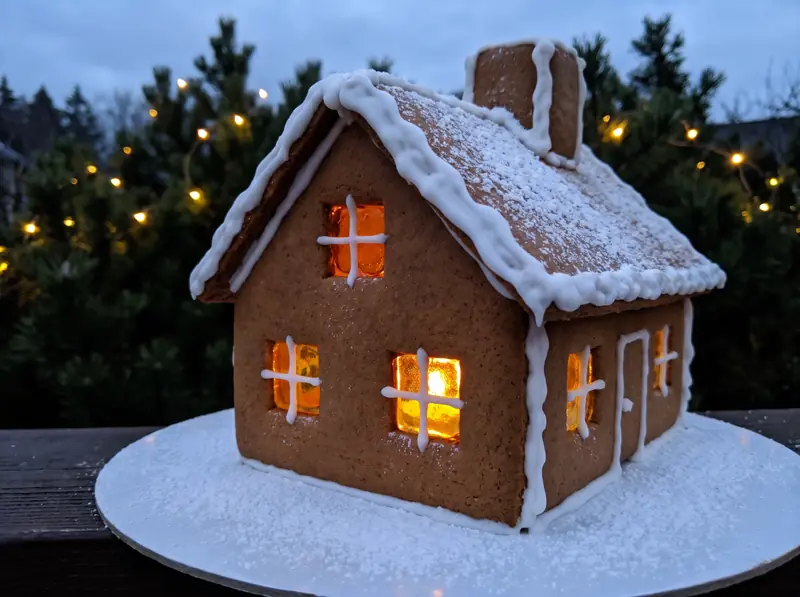
Glowing stained-glass windows are melted hard candy. Here is how to make them, and a template generator that cuts the window openings for you.
Candy-glass windows
The glowing windows in the 3D preview are melted hard candy. This house has 12 windows and needs about 9 hard candies (60 g).
What you need
- See-through hard candies, such as lemon drops, Jolly Ranchers, fruit drops or butterscotch. Yellow and orange give the warm glow in the preview.
- Baking paper or a silicone mat. Melted candy sticks to a bare tray and to foil.
- A zip bag and a rolling pin for crushing.
How to make them
- Sort the candies by color, put them in a zip bag and crush them with a rolling pin into coarse grit.
- Cut the pieces, window openings included, on baking paper and leave them on the paper.
- Bake the pieces until they are nearly done, then take the tray out.
- Fill each window with crushed candy, level with the dough, not heaped.
- Bake for another 4 to 6 minutes, until the candy has melted flat and stopped bubbling.
- Let the pieces cool on the tray for 15 minutes, until the glass is hard, then peel off the paper.
- Pipe the window crosses on the glass with royal icing. The dashed lines in each window on the template show where.
- Adding the candy only for the last minutes keeps it clear. Baked the whole time, yellow candy turns brown.
- Mix colors inside one window for stained glass, as on the church.
- Light the house with a battery LED tea light placed inside before the roof goes on. A real candle melts the windows.
Which candy works
- Clear, see-through hard candies melt into clear glass. Lemon drops, Jolly Ranchers, fruit drops and butterscotch all work.
- Isomalt nibs from baking shops stay clear longest in damp air and do not brown easily.
- Milky, filled, chewy or sugar-coated candies melt cloudy or burn. Leave them for decorating the roof.
How much candy you need
Each window is filled level with the dough, so the amount depends on the window area and how thick you roll the dough. The generator works it out for the house and size you pick: about 9 hard candies (60 g) for this one.
- Footprint
- 13.6 × 21.6 cm
- Height
- 26.9 cm
- Dough
- 1.45 kg
- Baking sheets
- 2
- Candy for windows
- about 9 hard candies
If the windows go wrong
- The glass is cloudy or sticky
- Damp air softens candy glass. Assemble the house within a day or two and keep it away from kitchen steam. Isomalt stays clear longer.
- The candy turned brown
- It was in the oven too long. Add the candy only for the last 4 to 6 minutes. Yellow and clear candy show browning least.
- There are bubbles in the glass
- Crush the candy finer and spread it evenly. Prick big bubbles with a toothpick as soon as the tray comes out.
- A window cracked or fell out
- The piece was moved before the glass set. Leave it on the tray for 15 minutes, then slide the baking paper off in one go.
- Candy ran under the dough
- The window was overfilled or the paper was not flat. Fill only level with the dough and bake on a flat tray.
More house templates
Gingerbread house template
Gable roof, chimney and four windows. The one most people picture.
Small gingerbread house template
Bakes on one tray. Good for kids and first-timers.
Mini gingerbread house template
Six centimeters wide. Mug toppers and mini villages.
Large gingerbread house template
A centerpiece. Big pieces print as tape-together tiles.
A-frame gingerbread house template
The easiest build: two triangles and a roof.
Gingerbread church and chapel template
Bell tower, steeple and arched windows.
Two-story gingerbread house template
Tall walls and two rows of windows.
Gingerbread barn template
Gambrel roof and a wide braced door.
Gingerbread log cabin template
Shallow roof and log lines to decorate.